
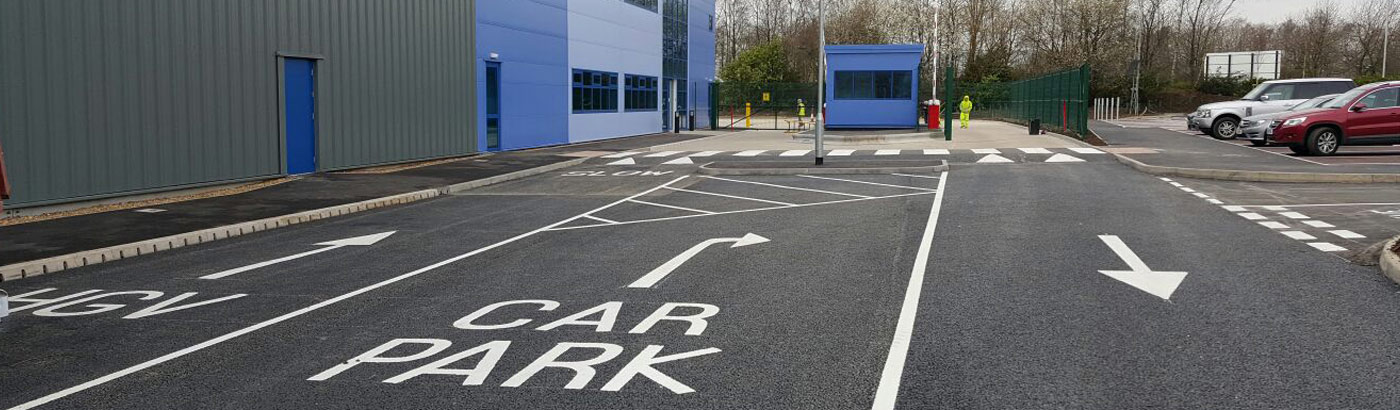
Business parks and industrial estates can experience a constant mix of cars, vans, HGVs, delivery vehicles, forklifts, employees and visitors. Without clear road markings, even a well-designed site can quickly become difficult to navigate.
Effective road markings for business parks help drivers understand where to travel, park, stop and give way, while pedestrian routes, loading zones and safety markings help organise movement across the wider site.
For industrial estates in particular, where large vehicles and frequent deliveries are common, clearly defined markings can support safer traffic management and make everyday operations easier to control.
Contact Us | View Our Road Marking Service
Why Are Clear Road Markings Important on Commercial Sites?
Commercial sites often contain several different areas with different purposes. A typical business park or industrial estate may include staff and visitor parking, delivery entrances, loading and unloading areas, HGV routes, pedestrian walkways, fire access routes, service yards, disabled parking spaces, EV charging bays, no-parking zones, give-way points and directional traffic routes.
Without visible markings separating these areas, drivers may be unsure where they should go or where they are permitted to stop.
Well-planned commercial site line markings provide clear visual instructions that make the layout easier to understand. They can help reduce unnecessary vehicle movements, improve parking organisation and support safer interaction between vehicles and pedestrians.
Gilvar Lining provides a range of professional road marking services for commercial sites requiring clear, practical layouts.
How Do Road Markings Improve Traffic Flow Around Business Parks?
Traffic flow is one of the main reasons businesses invest in professional line marking.
On a busy commercial estate, confusion at junctions, entrances or loading areas can quickly create congestion. Vehicles stopping in unsuitable locations may block access routes, while unclear directional systems can cause drivers to make unnecessary manoeuvres.
Clear road markings can help create a logical traffic system across the site. Directional arrows, give-way markings, stop lines, lane divisions, one-way systems, turning areas, junction markings, hatching and loading bay boundaries can all help guide drivers through the site more efficiently.
For sites where drivers regularly struggle to find their way around, Gilvar Lining has also explained how clear car park markings can improve direction.
Why Are Industrial Estate Road Markings Important for HGV Movement?
Industrial estates often need to accommodate larger vehicles than conventional office or retail sites.
HGVs require more room to turn, reverse and manoeuvre, particularly around warehouses, loading bays and distribution centres.
Industrial estate road markings can be used to identify HGV routes, loading bays, reversing zones, turning circles, trailer parking areas, waiting areas, restricted access zones and pedestrian exclusion areas.
Clear markings help drivers understand where large vehicles should travel and where they should not be positioned.
How Can Line Markings Improve Pedestrian Safety?
Vehicles are only one part of the traffic-management challenge.
Business parks and industrial estates can have large numbers of employees, contractors and visitors walking between car parks, offices, warehouses and other facilities.
Industrial site safety markings UK businesses use can help create visible separation between pedestrians and moving vehicles.
Pedestrian walkways, crossing points, hatched safety zones, no-entry areas, warehouse access markings, symbols and warning text can all help make movement around a site easier to understand.
Where possible, pedestrian routes should be easy to identify and positioned to reduce unnecessary interaction with vehicle traffic.
Markings alone are not a complete safety system, but they can form an important part of wider site planning alongside signs, barriers, lighting and operational procedures.
For sites where vehicles, forklifts and pedestrians operate in close proximity, warehouse floor markings can also improve workplace safety.
Why Are Car Park Markings Important on Business Parks?
Parking is one of the most visible areas of site organisation.
Poorly defined or faded bays can lead to inconsistent parking, wasted space and vehicles being left too close to access points, pedestrian routes or neighbouring spaces.
Clear business park car park markings can define standard parking bays, disabled parking spaces, visitor parking, staff parking, motorcycle spaces, EV charging bays, loading areas, no-parking zones and pedestrian walkways.
A clearly marked car park can help site users understand where they should leave their vehicle while supporting a more organised appearance across the wider estate.
For sites with limited parking capacity, an accurately planned layout may also help make more efficient use of the available space.
Gilvar Lining offers dedicated car park marking services for commercial premises, while its guide to car park line marking covers additional considerations when planning a new or refreshed layout.
Where electric vehicle facilities are being introduced, clearly marked EV charging bays can also help distinguish charging spaces from conventional parking.
Can Clear Markings Improve Site Organisation?
Yes. Line markings are useful not only for safety but also for making the purpose of different areas immediately understandable.
Large industrial and commercial sites can contain areas that appear similar when viewed from ground level. Clear markings can distinguish between parking areas, delivery zones, storage areas, vehicle routes, pedestrian zones, loading bays, fire access routes, restricted areas and waiting zones.
This makes it easier for employees, visitors and contractors to understand how the site is intended to operate.
For facilities managers, clear markings can also make site rules easier to communicate because the physical layout reinforces those instructions.
What Types of Markings Can Be Used on Industrial Sites?
The marking system should be selected according to the location, surface and expected traffic.
Parking Bay Markings
Parking bays help organise staff, visitor and fleet parking.
They can also be combined with symbols or coloured areas to identify specific types of parking.
Directional Arrows
Arrows provide simple visual guidance at junctions, entrances and circulation routes.
They can be particularly useful for one-way systems and unfamiliar delivery drivers.
Loading Bay Markings
Loading areas need clear boundaries so drivers can position vehicles appropriately and other users understand where parking may be restricted.
Pedestrian Walkways
Marked pedestrian routes can help separate people from moving vehicles and guide them towards entrances, exits or crossing points.
Hatching and Exclusion Zones
Hatched areas can show locations that should remain clear.
These might include entrances, turning points, loading access or other operational areas.
Safety Symbols and Lettering
Text, symbols and warning markings can provide additional information where lines alone are not sufficient.
Examples may include STOP, KEEP CLEAR, pedestrian symbols, numbering and designated bay information.
For a broader overview of common symbols and layouts, see Gilvar Lining’s guide to what different road markings mean.
What Materials Are Used for Commercial Site Line Marking?
There is no single marking material suitable for every business park or industrial estate.
The appropriate choice depends on the surface type, whether the area is indoors or outdoors, vehicle volumes, HGV traffic, required durability, reopening requirements, colour, existing coatings and environmental conditions.
Thermoplastic is commonly associated with external roads and car parks, while specialist paint, MMA, epoxy or other coating systems may be appropriate for different commercial and industrial environments.
For more information about one of the most widely used external systems, read Gilvar Lining’s guide to thermoplastic road markings.
Industrial premises may also require dedicated factory floor markings where internal surfaces, forklift movements or operational zones require a different specification.
A road marking contractor should assess the individual site before recommending a particular system.
When Should Business Park Road Markings Be Refreshed?
There is no universal timetable because wear varies significantly between sites.
A quiet office park may experience very different traffic from a busy distribution estate operating around the clock.
It is sensible to inspect markings regularly and consider refreshing them when parking bays are difficult to distinguish, arrows or junction markings have faded, pedestrian routes are becoming unclear, new operational areas have been introduced, the traffic layout has changed or old markings conflict with the current system.
Heavy wear around turning areas can also be a sign that renewal is needed, particularly where HGVs or other large vehicles manoeuvre regularly.
If visitors, staff or delivery drivers are frequently struggling to navigate the site, that can also indicate that the existing marking layout needs attention.
Waiting until markings have almost disappeared can make the layout unnecessarily difficult to interpret.
The guide on how often car park line markings should be repainted provides further advice for facilities managers reviewing maintenance schedules.
Should You Review the Layout Before Re-Marking?
In many cases, yes.
Simply repainting every old line in exactly the same place can mean restoring a layout that no longer reflects how the site is used.
Business parks and industrial estates change over time. A site may now have more employees, larger delivery vehicles, additional warehouse units, new EV charging points, revised entrances, more pedestrian traffic or different loading arrangements.
Before re-marking, it can therefore be useful to review whether the existing layout still works efficiently.
This is particularly important where drivers regularly experience congestion or where informal parking has developed in areas that were not originally intended for vehicles.
How Can Poor Road Markings Affect Day-to-Day Operations?
Faded or poorly planned markings can create practical problems long before they become completely illegible.
Drivers may park across more than one bay, delivery vehicles may stop in unsuitable areas and staff may begin using informal routes because designated routes are unclear.
On an industrial estate, even minor confusion can cause delays if vehicles need to reverse, reposition or wait for blocked access points to clear.
Poorly organised traffic movement can also make the site more difficult for visitors and contractors who do not already know the layout.
Clear commercial site line markings help remove some of that uncertainty by giving users immediate visual instructions.
H2: Frequently Asked Questions
Why Are Road Markings Important on Business Parks?
Road markings help organise parking, direct vehicle traffic, identify pedestrian areas and clarify how different parts of the site should be used.
This can improve traffic flow and make the site easier for employees, visitors and delivery drivers to navigate.
What Road Markings Do Industrial Estates Usually Need?
Requirements vary from site to site, but common industrial estate road markings include parking bays, directional arrows, HGV routes, loading zones, pedestrian walkways, hatching, stop lines and safety markings.
The right combination should be based on how vehicles and pedestrians actually move around the premises.
Can Road Markings Help Prevent Congestion?
Clear arrows, lanes, junction markings and parking restrictions can help make vehicle movements more predictable and discourage parking in areas that need to remain open.
They cannot remove every cause of congestion, but they can help create a more understandable traffic system.
How Often Should Commercial Site Road Markings Be Repainted?
There is no fixed schedule for every site.
Traffic volume, vehicle type, surface condition, weather and the marking material all influence wear.
Regular inspections are the best way to determine when renewal is necessary.
Can Existing Industrial Estate Markings Be Changed?
Yes.
Existing layouts can be reviewed and old markings can be removed or prepared before new lines are installed where required.
This can be useful when parking arrangements, loading operations or traffic flows have changed since the original markings were applied.
Can Road Marking Work Be Completed Around Business Operations?
Many commercial projects can be planned in phases or scheduled around quieter periods to reduce disruption.
The most appropriate approach depends on site access, traffic movements and the scale of the work.
What Is the Best Material for Business Park Road Markings?
There is no single best material for every business park.
The choice depends on the surface, location, traffic levels, expected wear and required finish.
A contractor should assess the site before recommending a marking system.
Creating a Safer, Better Organised Commercial Site
Clear road markings play an important role in keeping business parks and industrial estates organised.
From parking bays and directional arrows to loading zones, HGV routes and pedestrian walkways, a well-planned marking system helps people understand how each part of the site should be used.
The best results come from considering the entire layout, including vehicle movements, pedestrian routes, parking requirements, surface condition and future operational needs.
Gilvar Lining provides professional road marking, car park marking and factory floor marking services for commercial and industrial sites, helping businesses create clear, durable layouts suited to the way their premises operate.
Contact Gilvar Lining to discuss your site or request a quote.


