
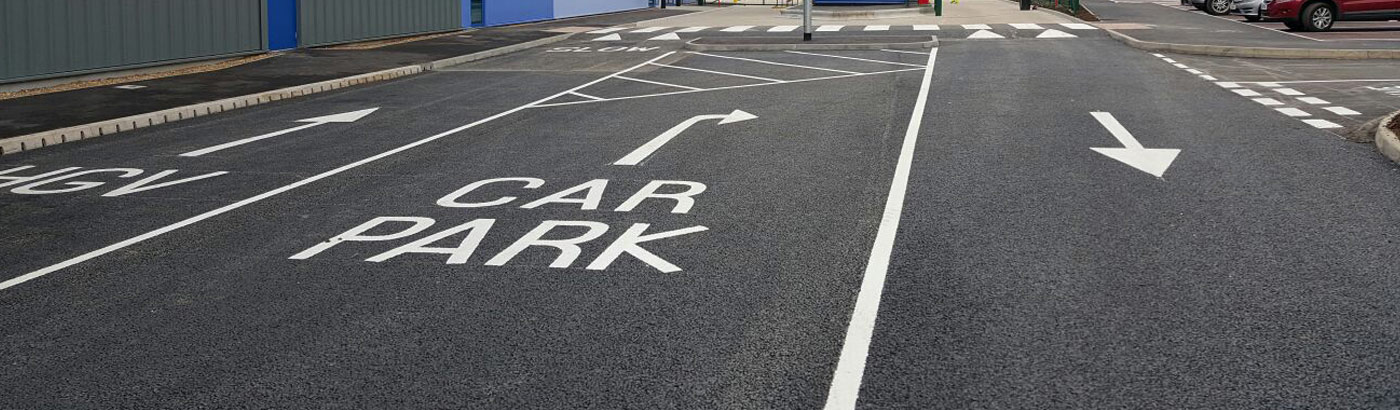
Freshly completed resurfacing can make a parking area look finished, but there is still an important stage to complete before normal use resumes.
Applying line markings after resurfacing involves more than simply recreating the old bays. The new finish needs to be checked, allowed to settle where necessary, cleaned and carefully set out before parking bays, directional arrows, access symbols and restricted areas are applied.
The exact process depends on the material beneath, the chosen application system, weather conditions and how the area will be used. There is no universal waiting period that applies to every project.
What Happens Immediately After Resurfacing?
Once the contractor has completed the new finish, the first job is not necessarily to start painting.
The area needs to be inspected to confirm that it is suitable for the next stage. Contractors may check for loose material, contamination, uneven areas or other issues that could affect adhesion.
Some treatments also need time to settle.
For example, West Sussex County Council explains that newly laid micro-asphalt can remain soft initially and may show tyre impressions while it beds in. Its programme normally includes follow-up sweeping before existing road markings are reinstated later. You can read its explanation of the process in its micro-asphalt resurfacing guidance.
This is why assuming that every newly completed area can be painted immediately can cause problems.
How Long Should You Wait Before Applying New Markings?
There is no single answer.
Curing time depends on several factors, including:
- The type of newly laid material.
- The product being applied on top.
- Weather and temperature.
- Moisture levels.
- Manufacturer instructions.
- Traffic requirements.
The Department for Transport’s Traffic Signs Manual states that road markings should be renewed as soon as reasonably possible after resurfacing or road works. It also recognises that permanent reinstatement may not always be immediately practical.
That guidance is useful because it highlights the balance involved. The markings should not be unnecessarily delayed, but neither should they be applied before the new finish is ready.
A professional contractor should therefore assess the new material rather than relying on an arbitrary rule such as “always wait 24 hours”.
Why Does Surface Preparation Matter?
Good surface preparation has a direct effect on how well the finished application performs.
Even a new parking area can contain:
- Dust
- Loose aggregate
- Moisture
- Oil or fuel contamination
- Construction debris
- Residue from previous works
These can interfere with adhesion.
Depending on the material and application specification, preparation may involve sweeping, cleaning, drying or removing loose debris before work starts.
The area should also be inspected for problems that might affect the finished result. Applying fresh material over contamination or unstable areas can lead to premature wear.
This is one reason the application stage should be coordinated with the resurfacing contractor rather than treated as an unrelated job.
Should You Copy the Old Car Park Layout?
Not automatically.
A completely renewed area creates a useful opportunity to review the car park layout before recreating what was there previously.
Ask whether the old arrangement still works for:
- Current vehicle numbers.
- Pedestrian movement.
- Accessible parking.
- EV charging.
- Loading requirements.
- Deliveries.
- Staff and visitor parking.
- Traffic direction.
If the layout has not been reviewed for many years, simply copying it can preserve existing problems.
The Health and Safety Executive’s workplace transport guidance recommends keeping pedestrians and vehicles apart where possible. It also notes that parking areas should not obstruct traffic routes, should provide clear visibility and should be clearly identified.
This means the period between resurfacing and repainting is an ideal time to reconsider how the space works.
For further planning advice, Gilvar Lining’s guide to car park line marking looks at the wider decisions involved in creating an organised parking area.
How Is the New Layout Set Out?
Once the design has been agreed and the area is ready, the next stage is setting out.
This is where the agreed car park layout is transferred onto the ground before permanent materials are applied.
Measurements need to be accurate because small errors can multiply across a large area. The contractor may establish reference points before setting out bays, traffic routes and other features.
Typical elements include:
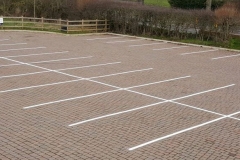
- Standard parking bays.
- Accessible spaces.
- EV charging bays.
- Pedestrian routes.
- Directional arrows.
- Hatched areas.
- Loading zones.
- Restricted spaces.
- Numbers or lettering.
The aim is to make the overall arrangement work as one system rather than treating each feature separately.
Why Should Pedestrian Routes Be Planned at the Same Time?
Parking bays are only one part of the finished layout.
People also need to move between vehicles, entrances and buildings.
The HSE advises that pedestrian and vehicle traffic routes should be separated wherever reasonably practicable and that crossing points should be clearly identified.
That could mean incorporating:
- Dedicated walkways.
- Crossing points.
- Buffer zones.
- Directional symbols.
- Physical barriers where appropriate.
These features should be planned before permanent application begins. Trying to add a walkway after every bay has already been positioned can reduce usable space or create awkward crossing points.
What Happens If Permanent Markings Cannot Be Applied Immediately?
Sometimes the new finish is not ready for permanent materials when an area needs to reopen.
The Department for Transport notes that temporary markings may be appropriate after resurfacing when permanent reinstatement cannot be completed immediately and the absence of guidance could create a hazardous situation.
This principle is particularly relevant to areas with:
- Busy junctions.
- One-way routes.
- Pedestrian crossings.
- Restricted traffic movements.
- Complex access arrangements.
Any temporary solution needs to be considered as part of the overall traffic-management plan.
It should not simply become a permanent substitute because the follow-up work has been forgotten.
How Quickly Can the Area Reopen Afterwards?
Again, there is no universal answer.
The reopening time depends on the product used, weather conditions and manufacturer specifications.
Some systems cure quickly, while others require more time before vehicles can drive over them.
Allowing traffic onto newly applied material too early can cause:
- Smearing
- Tracking
- Premature wear
- Poor edges
- Contamination
The contractor should confirm when the completed area can return to normal use.
For busy commercial properties, work can sometimes be phased so part of the parking area remains operational while another section is completed.
What Should Be Checked Before the Project Is Signed Off?
A final inspection should look beyond whether the new work appears bright and tidy.
Check that:
- Bays follow the approved plan.
- Symbols are correctly positioned.
- Directional arrows make sense from a driver’s approach.
- Accessible spaces have been applied as specified.
- Pedestrian routes remain clear.
- Restricted areas are obvious.
- Old instructions are not still visible and causing confusion.
- Edges and corners are complete.
A newly finished parking area is the easiest point at which to correct any layout problems, before normal traffic returns.
Should Resurfacing and Marking Be Planned Together?
Where possible, yes.
Treating resurfacing and line markings after resurfacing as connected stages can make the project easier to manage.
It allows the owner, surfacing contractor and application team to agree:
- When the area will be ready.
- What preparation is required.
- Whether the old design will change.
- Which material will be used.
- How traffic will be managed.
- When the property can reopen.
Planning both stages together can also reduce the risk of discovering too late that the old layout no longer suits the property.
For examples of completed commercial work, explore Gilvar Lining’s case studies.
What Is the Key Takeaway After Car Park Resurfacing?
A newly renewed parking area is a blank canvas, and that makes the next stage worth planning carefully.
The process normally moves from inspection and surface preparation, through appropriate curing time, to layout planning, setting out, parking bay markings, symbols and final checks.
Most importantly, do not assume that recreating the previous arrangement is automatically the right choice.
A full refresh gives you the chance to improve movement, accessibility and space usage before permanent materials go down.
If you are planning new line markings after resurfacing, contact Gilvar Lining to discuss the new finish, proposed layout and application requirements.


